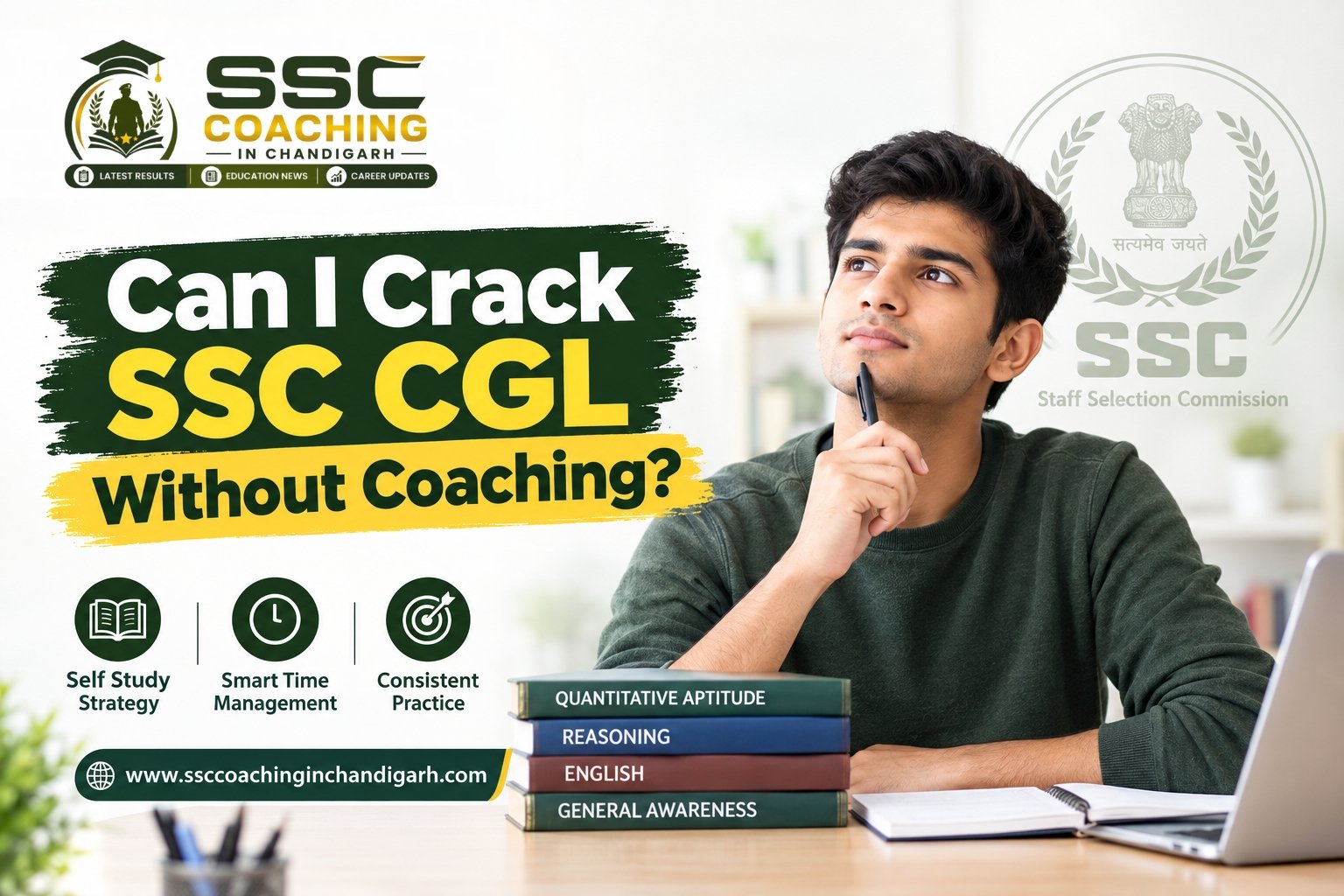

Yes, many aspirants can prepare for the SSC CGL examination through self-study if they have a clear strategy, reliable study material, consistent practice, and the discipline to follow a structured schedule. Coaching is not an absolute requirement, but guidance can help candidates avoid common preparation mistakes and stay accountable.
The Staff Selection Commission (SSC) Combined Graduate Level examination tests candidates across areas such as Quantitative Aptitude, Reasoning, English Language, and General Awareness. The examination also requires candidates to manage time effectively and maintain accuracy under pressure. According to the SSC CGL examination scheme, Tier-I includes 25 questions each from General Intelligence and Reasoning, General Awareness, Quantitative Aptitude, and English Comprehension, with negative marking for incorrect answers.
Therefore, the real question is not simply whether you need coaching. It is whether you can independently understand the syllabus, identify your weaknesses, practise consistently, analyse your performance, and improve before the examination.
Is Self-Study Enough to Crack SSC CGL?
Self-study can be sufficient for SSC CGL when it is organised around the actual examination requirements rather than random preparation.
A self-study candidate needs to take responsibility for several things that coaching normally provides, including:
- Understanding the complete syllabus
- Selecting reliable books and online resources
- Creating a realistic study timetable
- Learning concepts from the basics
- Solving previous year questions
- Taking regular mock tests
- Analysing mistakes
- Revising important topics
- Improving calculation speed
- Tracking progress consistently
The advantage of self-study is flexibility. You can spend more time on difficult subjects and move faster through topics you already understand.
However, flexibility can become a disadvantage if there is no fixed routine. Candidates may keep changing resources, postpone difficult chapters, or spend too much time watching lectures without enough question practice.
What Makes SSC CGL Self-Preparation Challenging?
SSC CGL preparation is not only about completing the syllabus. Candidates must also develop speed, accuracy, question-selection skills, and examination temperament.
Managing the Large SSC CGL Syllabus
The syllabus covers multiple subjects and different types of concepts. Quantitative Aptitude may require extensive calculation practice, while General Awareness requires continuous revision.
English and Reasoning also contain several recurring question types that become easier with regular practice.
Without a structured plan, candidates may focus heavily on their favourite subjects and leave weaker areas until the end.
Choosing the Right Study Resources
One common self-study problem is using too many resources.
A candidate may follow several YouTube channels, multiple books, different test series, and numerous Telegram or social media resources. Instead of improving preparation, this can create confusion.
A better approach is to select one dependable primary resource for each subject and supplement it only when necessary.
Getting Your Mistakes Corrected
In self-study, nobody automatically identifies why you are repeatedly making the same mistake.
For example, you may know the formula but lose marks because of calculation errors. Similarly, you may understand English grammar but choose incorrect answers because you misread the question.
This is why mock-test analysis is as important as taking the test itself.
How to Prepare for SSC CGL Without Coaching?
A self-study strategy should combine concept building, question practice, revision, and performance analysis.
Step 1: Understand the SSC CGL Exam Pattern
Start by checking the latest official SSC notification instead of relying on old preparation videos or outdated articles.
For the 2025 examination cycle, SSC’s official notification specified four sections in Tier-I, with 25 questions and 50 marks per section. It also specified a one-hour duration with sectional timers and 0.50-mark negative marking for each incorrect answer.
The Tier-II stage requires additional preparation. In the 2025 scheme, Paper-I included Mathematical Abilities and Reasoning and General Intelligence in Section-I, followed by English Language and Comprehension and General Awareness in Section-II, along with qualifying computer and data-entry components.
Because SSC can modify examination rules, candidates should always verify the latest notification before finalising their preparation plan.
Step 2: Divide the Syllabus into Smaller Topics
Do not try to complete an entire subject at once.
Break each subject into manageable sections.
For Quantitative Aptitude, you can begin with arithmetic topics such as percentages, ratio and proportion, averages, profit and loss, time and work, time and distance, and simple and compound interest.
For Reasoning, practise analogy, classification, series, coding-decoding, syllogism, blood relations, directions, and other recurring question types.
English preparation should cover grammar, vocabulary, comprehension, sentence improvement, error detection, cloze tests, and related areas.
General Awareness requires a combination of static subjects and current information relevant to the examination.
Step 3: Build Concepts Before Chasing Speed
Speed matters in SSC CGL, but speed without accuracy can reduce your score.
During the initial preparation stage, concentrate on understanding concepts and solving questions correctly.
Once you become comfortable with a topic, gradually introduce timed practice.
This approach helps you identify whether your problem is conceptual understanding, calculation speed, question interpretation, or time management.
Step 4: Make Previous Year Questions a Priority
Previous year questions are extremely useful for understanding the nature of SSC CGL questions.
They can help you identify:
- Frequently tested concepts
- Common question formats
- Difficulty levels
- Repeated patterns
- Topics requiring additional practice
- Your actual preparation gaps
Instead of solving previous year papers only at the end, include them throughout your preparation.
How Many Hours Should You Study for SSC CGL?
There is no universal number of study hours that guarantees success.
The ideal schedule depends on your current level, available time, educational background, and preparation timeline.
A candidate studying alongside college or work may have fewer hours but can still make progress with consistent focused study.
A practical daily schedule could include:
| Preparation Area | Suggested Focus |
|---|---|
| Quantitative Aptitude | Concepts + timed practice |
| Reasoning | Topic-wise questions |
| English | Grammar + vocabulary + practice |
| General Awareness | Static topics + current revision |
| Previous Year Questions | Daily or regular practice |
| Mock Tests | Weekly initially, increasing later |
| Analysis | Review incorrect and skipped questions |
The important factor is not simply the number of hours spent studying. Quality, consistency, and measurable improvement matter more than sitting at a desk for a fixed number of hours.
How Can Mock Tests Improve Self-Study?
Mock tests can show whether your preparation is translating into examination performance.
Do not treat a mock test merely as a score-generating exercise.
After every test, divide your questions into categories:
- Correct and confident
- Correct but took too much time
- Incorrect because of a concept gap
- Incorrect because of a silly mistake
- Skipped because you did not know the method
- Skipped because of time pressure
This analysis tells you what needs improvement.
For example, if Quantitative Aptitude takes too long, you may need calculation drills and timed sets. If your General Awareness score remains inconsistent, you may need a better revision system.
When Should You Consider SSC Coaching?
Self-study may work well for candidates who are disciplined, comfortable finding resources independently, and capable of analysing their own performance.
Coaching can become useful when you need structured guidance or are struggling to make consistent progress.
You may consider guided preparation if:
- You are starting from the basics.
- You struggle to create a realistic study plan.
- You repeatedly change study resources.
- You have difficulty understanding certain concepts.
- You need regular doubt-solving support.
- You lack accountability.
- Your mock scores are not improving despite practice.
- You want structured classroom preparation.
A coaching programme does not replace individual practice. Candidates still need to revise, solve questions, take mocks, and work on their weaknesses.
Self-Study vs Coaching: What Should You Choose?
The right preparation method depends on your individual circumstances.
| Factor | Self-Study | Coaching |
|---|---|---|
| Study schedule | Fully flexible | More structured |
| Learning resources | Selected independently | Usually organised |
| Doubt solving | Self-managed | Guided support available |
| Performance tracking | Candidate manages it | Often supported by tests and analysis |
| Discipline | Requires strong self-management | Regular classes provide structure |
| Cost | Usually lower | Higher than self-study |
| Personalisation | Depends on the candidate | May include guided support |
There is also a middle path.
Candidates can prepare primarily through self-study while using selected test series, online classes, doubt-solving resources, or occasional expert guidance.
The goal should be to build a preparation system that you can follow consistently.
How Can SSC Coaching in Chandigarh Help?
SSC Coaching in Chandigarh can provide a structured environment for candidates who want expert guidance alongside regular self-study.
A well-designed programme can combine classroom learning with focused practice in Quantitative Aptitude, Reasoning, English Language, and General Awareness.
Regular mock examinations and performance evaluations can help candidates understand where they are losing marks. Previous year question analysis can also make preparation more aligned with the examination pattern.
At SSC Coaching in Chandigarh, students can receive structured study resources, expert mentorship, doubt-solving support, mock examinations, and performance-focused preparation. The emphasis is on conceptual clarity, speed, accuracy, and time management rather than simply completing chapters.
This can be particularly useful for aspirants who find it difficult to maintain a consistent preparation routine on their own.
Common Mistakes in SSC CGL Self-Study
Self-study becomes less effective when preparation lacks direction.
Some common mistakes include:
Using Too Many Books and Online Resources
More resources do not necessarily mean better preparation. Select dependable material and revise it thoroughly.
Ignoring Previous Year Questions
Studying concepts without understanding how SSC applies them can leave you underprepared for actual questions.
Taking Mocks Without Analysing Them
A mock score alone does not explain your weaknesses. Spend time reviewing incorrect, doubtful, and time-consuming questions.
Focusing Only on Strong Subjects
Strong subjects can provide confidence, but neglected areas can limit overall performance.
Delaying Revision
Learning a topic once is not enough. Schedule repeated revision, particularly for formulas, vocabulary, facts, and frequently forgotten concepts.
A Practical Self-Study Plan for SSC CGL
If you want to prepare without coaching, create a preparation cycle rather than relying on motivation.
Phase 1 – Foundation: Understand the syllabus and learn basic concepts.
Phase 2 – Practice: Solve topic-wise and previous year questions regularly.
Phase 3 – Speed Building: Introduce timed sectional tests and improve calculation speed.
Phase 4 – Mock Practice: Take full-length tests under examination-like conditions.
Phase 5 – Analysis: Identify recurring mistakes and revise weak areas.
Phase 6 – Final Revision: Focus on formulas, vocabulary, important facts, previous mistakes, and high-priority topics.
Repeat this cycle until your performance becomes more consistent.
Final Thoughts on Cracking SSC CGL Without Coaching
So, can I crack SSC CGL without coaching? Yes, self-study can be a viable preparation route when you have discipline, reliable resources, a realistic timetable, regular practice, and detailed mock-test analysis.
Coaching is not a substitute for personal effort, but structured guidance can make preparation more organised for candidates who need mentorship, doubt-solving, regular testing, and performance tracking.
Whether you choose complete self-study, coaching, or a combination of both, the fundamentals remain the same: understand the syllabus, practise previous year questions, improve speed and accuracy, revise consistently, and analyse your performance.
If you want structured guidance, expert mentorship, regular mock tests, and focused preparation for SSC examinations, connect with SSC Coaching in Chandigarh and take the next step towards building a disciplined SSC CGL preparation strategy.
Frequently Asked Questions
1. Can I crack SSC CGL without joining coaching?
Yes. Candidates can prepare through self-study if they have reliable resources, a structured timetable, consistent practice, and the discipline to analyse and improve their performance.
2. How should I start SSC CGL preparation without coaching?
Start by checking the latest official SSC notification and syllabus. Then divide the subjects into topics, build concepts, solve previous year questions, practise regularly, and introduce mock tests as your preparation progresses.
3. Is self-study enough for SSC CGL Tier-II?
Self-study can cover the required subjects, but Tier-II preparation needs focused practice, speed improvement, accuracy, mock testing, and familiarity with the applicable examination components.
4. How important are previous year questions for SSC CGL?
Previous year questions help candidates understand question patterns, frequently tested concepts, difficulty levels, and areas where additional practice may be required.
5. When should I join SSC coaching instead of self-studying?
Consider structured coaching if you struggle with planning, need regular doubt-solving, find it difficult to stay consistent, or cannot identify why your mock-test performance is not improving.